“You remember that climbing pole I gave Professor Kitai for his birthday a few years back?”
Of course I did. That idiot dragged me along to pick it out, then chickened out and said it was from Kiyoko, Kitai’s daughter. The professor loved it—took it everywhere, showing it off to anyone who’d listen.
“Did it fall into a crevasse?” I asked.
“I wish,” Mita said, his face grim. He hesitated, then spoke slowly. “That pole was frozen inside the ice.”
“Frozen in the ice?” I blinked. “Are you serious?”
Glaciers take tens of thousands of years to form. Stuff that falls into crevasses either gets swept to the bottom and washed out at the base years later or stays lodged in a crack for future climbers to find.
“I’m not mistaken,” he insisted. “It was that pole—frozen a meter deep in the ice, not just sitting on the surface.”
“You must’ve seen it wrong,” I said, brushing him off and urging him to catch up with Chen and Wang.
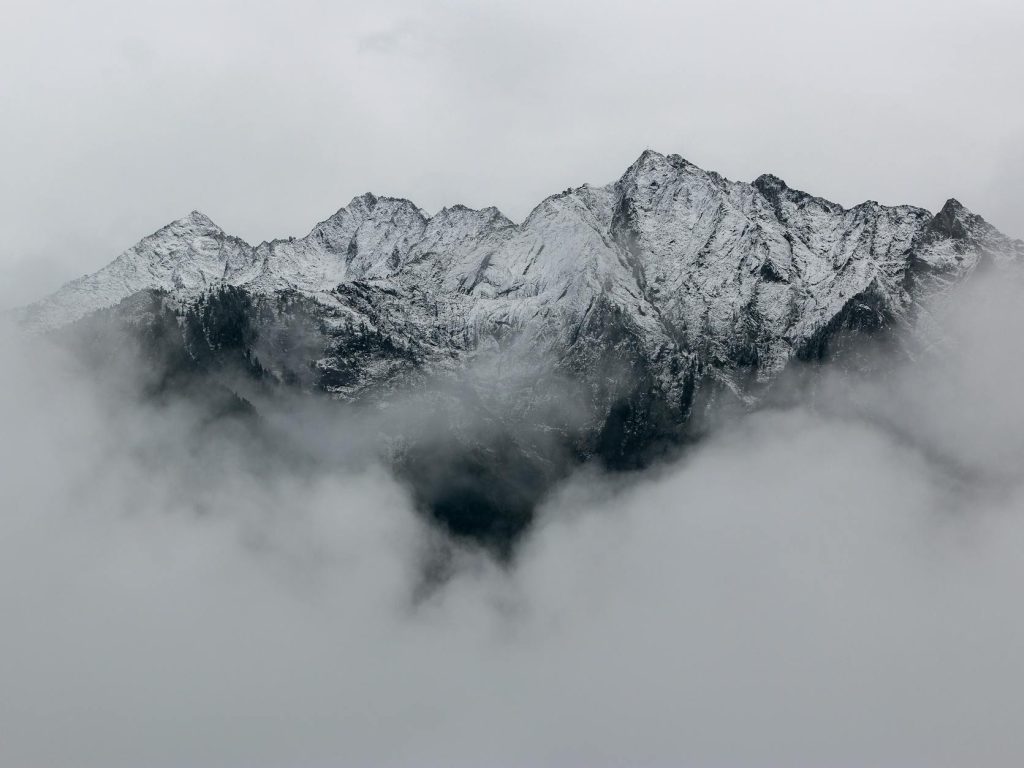
Mist was rising from the valley, closing in fast. Getting separated now would be a hassle.
We both knew something about this mountain felt off. Better to stay cautious.
When we caught up to Chen and Wang, they were arguing. Wang swore he’d seen something; Chen chalked it up to oxygen deprivation playing tricks on him.
No time for debates—we’d just roped up when thick fog rolled in. Moving carefully, Wang suddenly pointed to our right. “Look!”
About 30 meters away, a group of figures was moving across the glacier. The fog was so dense we could only make out vague shadows. I wondered—our own reflections, maybe? But this route was ours alone.
Then I counted them. Seventeen shadows.
Mita and I exchanged a glance. Our rescue team didn’t have that many people, and aside from the missing expedition, no one else should’ve been up here.
“Hey, don’t move! I’m coming over!” Wang shouted at them.
The figures didn’t respond, just kept moving toward the summit at an eerie pace.
Panicking, Wang veered right to follow. Chen sensed trouble and tried to call him back, but it was too late.
Wang stepped onto a hidden ice cap—a thin shell over a bottomless crevasse. Rushing forward, he didn’t check the ice’s thickness. It shattered under his weight, and he fell.
The rope yanked Chen down with him. Instinct kicked in—Chen flipped over, slamming his ice axe into the glacier, but he couldn’t stop the slide toward the crevasse’s edge.
Mita and I dropped to the ground, digging our crampons into the ice and pulling the rope taut. It bit into our gloves, our hands numb with pain.
It took nearly half an hour to haul them both up.
Wang’s fall threw off our morning’s progress. Chen bruised his left elbow in the slide, but it wasn’t serious. Wang, though, hit his head—possible mild concussion. We rested, keeping an eye on him.
“‘You all saw it too, didn’t you?’
The first to break the silence during lunchtime was Mita.Then, a hush fell over us.
‘I don’t know what I saw. The fog was too thick at the time. There was no way to be sure.It could’ve been our own reflections, or maybe an illusion caused by the refraction of light.’ As the team leader, Chen Ming analyzed the situation calmly and composedly.
Though there was another possible explanation, none of the four of us believed that a stranded team, lacking food and equipment, could still have all its members survive after ten days.
Moreover, the speed at which that group had moved just moments ago— even seasoned climbers like me and Mita wouldn’t have been confident in catching up.
It didn’t seem like the first expedition team, a mix of scholars and researchers, nor did it resemble the strength and spirit of people who’d been stranded on the mountain for ten days.
‘Perhaps it was a climbing party from a distant place, and the light and shadows just happened to project them in front of us,’ Mita chimed in, echoing Chen Ming’s attempt to find a rational explanation for the figures we’d seen.
But I think all four members of our team knew deep down that what we’d just witnessed wasn’t an illusion—something had undeniably passed by us. After lunch, the afternoon’s journey felt comparatively easy. On our way to C2, we walked along the mountain’s ridgeline.
At this altitude, oxygen tanks weren’t yet necessary. The team’s order remained the same: Chen Ming led the way, followed by Wang Yi, then me, with Mita bringing up the rear.
Around three o’clock, I spotted something strange again. On the ridgeline between the main peak and the side peak in the distance, there seemed to be something up there. So I pulled out my binoculars from my backpack, wanting to confirm what it was.
I wish I hadn’t looked.
Through the lenses, I saw what appeared to be five human figures, standing in a row, facing away from us. For a moment, I thought, ‘Oh, they must have successfully summited. That’s great.’ But then a chill shot up my spine. No, something’s wrong. Who are they?
If the first team was safe and sound, why hadn’t they contacted base camp in over ten days? And if they had the energy to summit, shouldn’t they have descended for help first?
What’s more, the ridgeline where those five figures stood didn’t belong to any of the three glacier routes.
Under normal circumstances, no one would go there. Even with the right gear, climbing that treacherous ridge wouldn’t be easy.
As I wrestled with these questions, the first of the five figures suddenly fell. I couldn’t help but cry out.
“Then the second, the third, the fourth, the fifth—one by one, in sequence, they dropped off the other side of the mountain.
In all my years of climbing, I’ve seen fellow climbers slip off cliffs more than once and witnessed people swept into valleys by gusts of wind, but the way these five fell was too unnatural. It reminded me of something I’d seen on TV years ago—in some Central Asian country, after a people’s revolution toppled a dictator, they pulled down his statue. The way it fell, body rigid and straight, tipping forward—that’s how these five figures dropped.
Hearing my shout, Mita rushed up from behind, asking what had happened. I froze, unsure whether to tell him what I’d just seen. When I looked back at the peak, it was once again shrouded in clouds—a vast expanse of white. Not only were the figures gone, but even the ridgeline had vanished from sight. I waved to Mita, signaling that it was nothing, but he clearly didn’t believe me, his face full of suspicion.
Finally, Mita leaned close to my ear and whispered so quietly I could barely hear: ‘Be careful. It feels like we’re not the only ones on this route. I don’t know if it’s just my imagination, but ever since we started climbing, I’ve had this strange feeling of being watched.’ His words startled me.
Indeed, both of us had climbed peaks over 8,000 meters multiple times. Our climbing experience was vast, yet this was the first time a mountain had radiated such intense hostility. This odd, unsettling feeling—it was as if the mountain itself was protesting our presence. Now that I think about it, I was such a fool.
I’ve always taught others that if you sense something strange on a mountain, you should descend immediately, no hesitation. I’ve seen too many people ignore their instincts, relying on past experience and skill, only to lose their lives on the mountain in the end. But when it was my turn to feel something off, I arrogantly assumed it was fine. Overconfident in my own abilities and those of my team, and eager to complete the search mission we’d been assigned, I ended up stepping onto a path of no return.
 True TAIWAN Horror story
Leave a comment