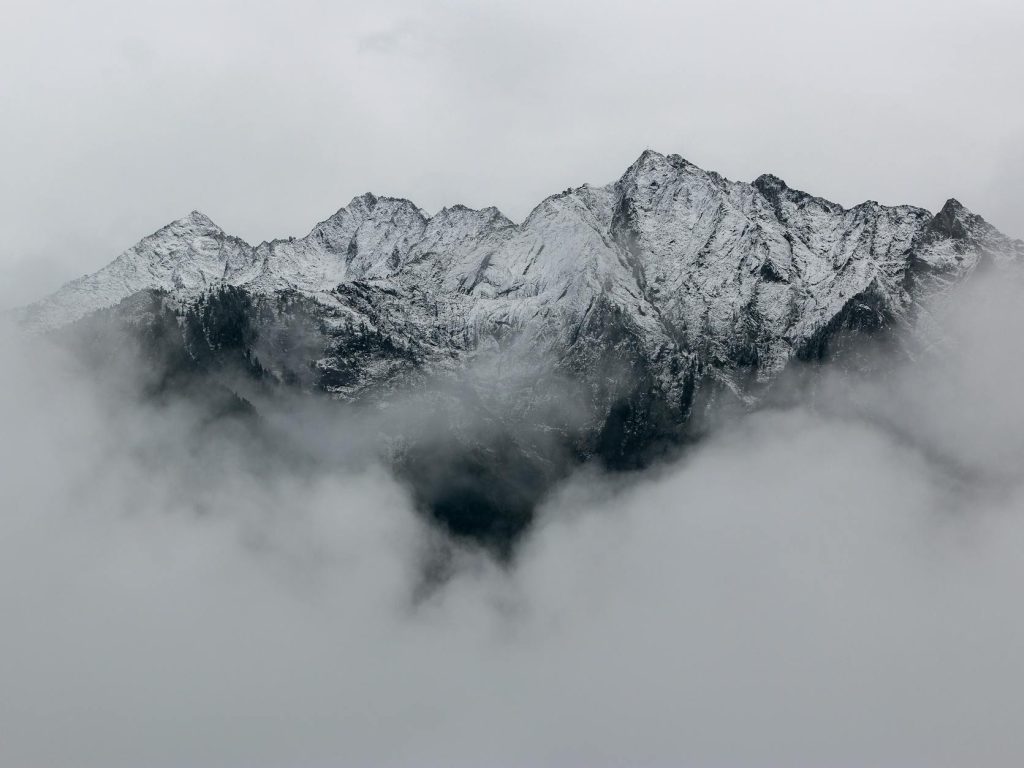
Kawagebo Peak has three mountaineering routes, namely three glaciers, each named after the village at the glacier’s exit.
The earliest mountaineering team climbed via the closest route, the Mingyong Glacier route. After multiple failures, they switched to the Sinong Glacier route.
However, while climbing the Sinong Glacier route, the team reached 5,400 meters and encountered a massive obstacle they could not overcome, determining that this route was unusable.
Thus, in 1991, an international mountaineering team switched to the Yubeng Glacier route, establishing camps at BC (Base Camp) 3,500 meters, C1 4,500 meters, C2 5,300 meters, C3 5,100 meters, and C4 5,900 meters.
The highest point reached was 6,470 meters, where they declared the summit attempt a failure. On the evening of January 3, 1991, at 22:00, the last radio contact between C3 and BC was made.
On February 7, 1991, a joint memorial ceremony hosted by the Chinese Mountaineering Association was held in Beijing.
On March 17, a joint memorial ceremony hosted by the Kyoto University Mountaineering Club was held in Kyoto.
From April to June, a joint search team was unable to reach C1 due to severe weather conditions.
From April 25 to May 9, the first group of bereaved families visited Deqin, with 18 Japanese and 8 Chinese family members participating.
On May 1, a memorial stele was unveiled at Feilai Temple in Deqin County, attended by the bereaved families. This stele has since been relocated.
On June 5, a monument was unveiled in Huairou County, Beijing.
From January 1 to 8, 1992, eight Japanese bereaved family members visited China, traveling to Beijing and Kunming.
On January 4, a one-year memorial ceremony hosted by the Yunnan Provincial Sports Committee was held in Kunming, attended by Chinese and Japanese bereaved families.
In January, the Kyoto University Mountaineering Club published the Meili Snow Mountain Accident Investigation Report.
On April 25, 1993, a memorial stele was unveiled on Mount Hiei in Kyoto, attended by Japanese bereaved family members.
From March 28 to April 3, 1994, Chinese bereaved family members visited Japan, traveling to Tokyo, Kyoto, and Osaka.
From April 22 to May 6, 1994, the second group of bereaved families visited Deqin, with 14 Japanese family members participating.
Although the Chinese Mountaineering Association received climbing applications from countries such as the United States, New Zealand, Switzerland, and Taiwan, Yunnan Province reserved the first ascent rights for Japan for five years. From October to December 1996, a joint team from Kyoto University and China made a third attempt to climb Kawagebo Peak. However, due to forecasts of a blizzard, the team was forced to retreat, failing to summit once again. They withdrew from the camp on December 8, having reached an altitude of 6,250 meters.
In 1990, local residents welcomed the joint mountaineering team. However, in 1996, Tibetan residents opposed the climbing activities, demanding payment from the Japanese team for passage and obstructing the expedition with acts of theft. This difference may stem from a distinction in local perceptions of Meili Snow Mountain and Kawagebo Peak compared to general understanding. Local resistance grew as they realized the team’s target was the sacred Kawagebo Peak, compounded by the fact that some locals did not share in the benefits of the climbing activities.
In July 1998, remains and artifacts were discovered downstream of C3 along the Yongming Glacier at 3,700 meters, 3,600 meters, and 3,400 meters.
Subsequent searches for remains, artifacts, or identification efforts continued until 2009.
On August 7, 1999, the Meili Snow Mountain Warriors Monument was unveiled in Beijing. Over 100 people, including Chinese and Japanese officials, relatives of the deceased, and their friends, attended the unveiling ceremony.
In 2000, official memorial activities ceased.
In 2000, the Deqin County People’s Congress legislated a ban on climbing the main peak of Kawagebo. To this day, no successful ascents of any significant peaks of Kawagebo have been recorded.
In 2006, Shorya Kobayashi published Meili Snow Mountain: Searching for Seventeen Friends on this topic. In 2021, the Chinese edition of the book was released.”
Reposted from PTT Marvel Board
Time stamp: Nov 3 17:28:49 2015


 True TAIWAN Horror story
Leave a comment