This is actually a story about my childhood neighbor (let’s call him Albert).
Albert and I hadn’t seen each other for over ten years, until we met again last week during New Year’s Eve.
We were originally heading to a party, but while standing outside smoking, we started chatting and ended up talking until dawn! I felt that his story—or rather, his entire family’s experience—was just too WOW. With Albert’s permission, I’ve organized it and posted it here to share with everyone.
When I was a kid, I lived in a community in Taipei.
Including my parents, there were four or five households who had agreed to take turns looking after the kids in the evenings. So every day after school, I’d hang out with a few neighborhood kids, gathering at someone’s house to chat, watch TV, or do homework.
Among them, Albert and I were the closest. His family had the biggest place—they’d bought and connected two units on the same floor. I still remember that right by the entrance on the left was a shrine with statues of gods and ancestral tablets. But next to that shrine was another smaller one, dedicated to “Lord Zhao.”
Speaking of this Lord Zhao, he’s incredible—apparently, their family’s rise to prosperity was all thanks to him.
Back during the Chinese Civil War (yes, it goes that far back! 1949!), when the Chinese Nationalist Party (KMT) were on the verge of collapse and the mainland was about to change hands, Albert’s grandfather (let’s call him Grandpa ) got word from relatives in Xiamen urging him to hurry there to join them and retreat to the “treasure island” of Taiwan together. (Though they didn’t know back then that, half a century later, this “treasure island” would be nicknamed the “ghost island”—so spooky! Fate’s wild, so WOW!)
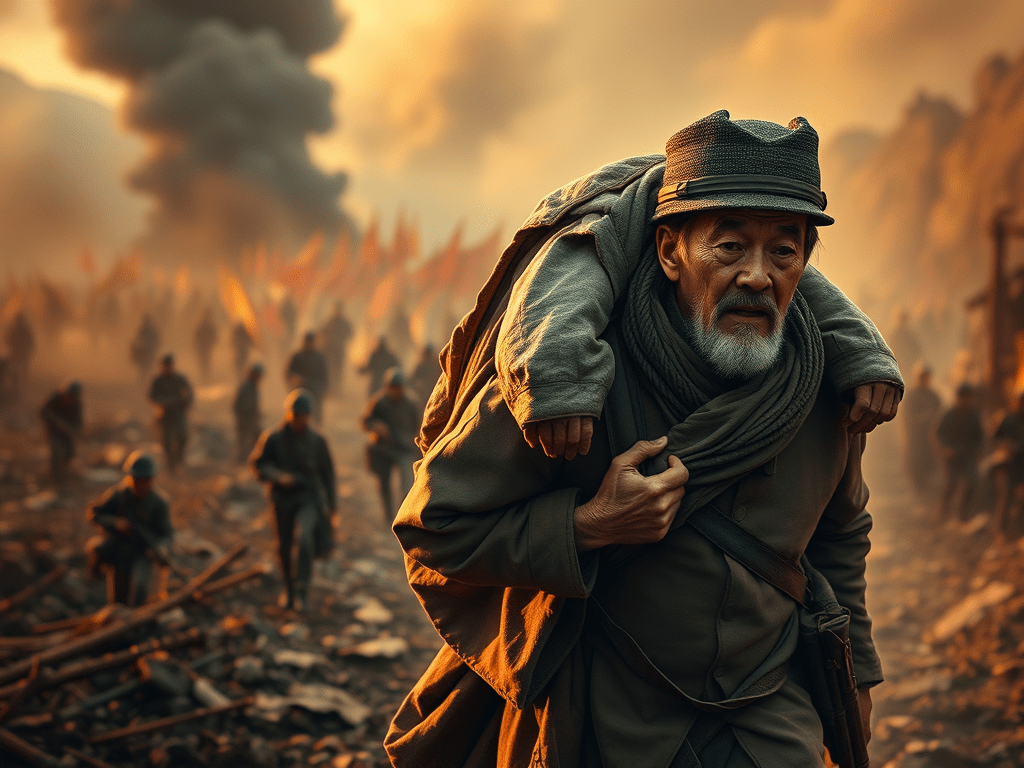
Grandpa hurriedly set off with his sworn brother, “Lord Zhao.” Due to the war, Grandpa already had a limp in one leg. But halfway there, he slipped and broke the other one too… Lord Zhao, true to their bond of brotherhood, carried Grandpa on his back all the way to Xiamen.
Lord Zhao was originally a scholar, not someone with great physical strength. Relying purely on willpower, he collapsed as soon as they reached Xiamen with Grandpa on his back. Grandpa himself was barely clinging to life. Amid the chaos, his relatives didn’t recognize Lord Zhao, took Grandpa onto the boat, and left. It was only after the ship set sail that Grandpa realized his savior had been left behind in Xiamen, China.
From then on, separated by vast seas, the two never saw each other again. Grandpa never forgave himself for it.
It wasn’t until the Reform and Opening-Up period (1978~) that Grandpa took his son back to their hometown. As soon as he got off the plane, he felt dizzy and sick, vomiting and suffering from diarrhea the whole way. Later, he learned that Lord Zhao had long since passed away, seemingly without leaving any descendants. Grandpa convinced that “Lord Zhao” knew he’d returned and had come to settle the score.
I don’t know the details of what happened next, but Grandpa made several trips back. Eventually, through a medium or spirit channeler, he managed to locate Lord Zhao’s grave—a few stone tablets stacked in a desolate mountain area. By then, Grandpa was probably in his seventies. He broke down crying in front of the grave, swearing:
“It was you who carried me all the way to Xiamen back then! I let you down. Now it’s my turn to carry you back to Taiwan, and my descendants will honor you forever!”
He arranged a ritual and brought Lord Zhao back to Taiwan.
Initially, Albert’s dad opposed it, thinking that since the man was dead, he should rest where he fell. But Lord Zhao had died in a foreign land with no family left back home. Grandpa, lonely in his old age, could never let go of this debt to his sworn brother. In the end, they figured if bringing him back and honoring him would give the old man peace, it wouldn’t hurt. So it was done.
Who could’ve guessed that after Lord Zhao was brought back, the Albert family would skyrocket to success?
Albert’s dad and Albert’s uncle had been running a mediocre business. But once “Lord Zhao” arrived, everything changed—their fortunes soared, and their business grew massively. Albert’s uncle soon took his wife and kids and immigrated to New Zealand.
Before Grandpa passed away, he reiterated that his descendants must honor Lord Zhao like a family elder. “This is what our family owes him,” he said.
At the time, his two sons and Albert’s older sister (who was probably ten years older than Albert) were all thriving in their careers. Privately, they all believed it was thanks to Lord Zhao’s blessings. Naturally, they patted their chests and promised to follow Grandpa’s instructions. Both sons and their wives even recognized Lord Zhao as a godfather. Only then did Grandpa pass away peacefully, ending his tumultuous life.
But the story doesn’t end there.
Before Grandpa Albert’s death, my family moved away from Taipei, and I lost touch with Albert and his family. It wasn’t until the Facebook era that we “became friends” again. But it was just the occasional “like” or a birthday message like, “Hey, remember when we did that thing? So dumb, haha!”—just pretending to stay familiar.
This New Year’s Eve, we happened to have a mutual friend throwing a party (thanks, Facebook !), and after over a decade, we finally met again. He’s now married with two kids.
That’s when I learned about how “Lord Zhao” had completely spiraled out of control later on.
Albert’s first child nearly miscarried.
Albert’s older sister is still hospitalized to this day.
And Albert’s uncle’s wife had an Exorcist-style episode at a Chinese church in New Zealand (though the pastor successfully “cut the soul tie” and “cleansed her” —— Amen!).
It was only later that Albert’s family realized what they’d brought back wasn’t “Lord Zhao” at all.
It wasn’t even a human soul.
It was the Wu-tong.
And not just one—a whole group of them.
Wutong Shen, or Wulang Shen, are a group of five sinister deities from the southern region of China. Their cult began in the Tang dynasty and are usually depicted as one-legged demons. By nature wanton and lascivious, the Wutong often disguised themselves as handsome gentlemen to seduce unsuspecting and vulnerable women. Women who were ravished or possessed by these creatures lost consciousness and endured painful fits and convulsions lasting for days, even weeks, which often brought them to the brink of death.
Repost from the PTT Marvel board (Taiwanese Reddit)
Writer : rawroll
Time stamp: Jan 7 21:14:35 2014

 True TAIWAN Horror story
Leave a comment