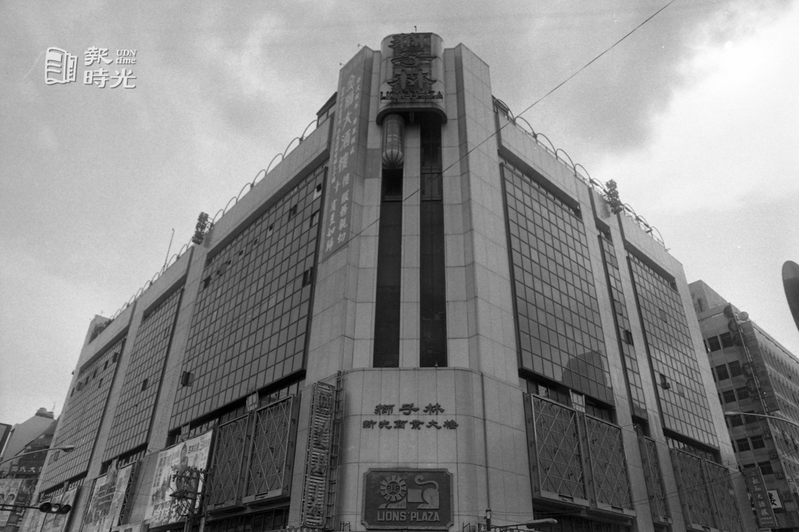
In 1976, the Lion Forest Building emerged as a groundbreaking architectural marvel in Taipei. With ten floors above ground and three below, it was a rare behemoth for its time. Its ambitious design included 300 shops across the first three floors, operating as a “consumer corridor.” The fourth floor housed three cinemas—“Golden Lion,” “Silver Lion,” and “Treasure Lion”—flanking a central “Snack World.”
Floors five to eight offered over 300 small suites and 40 duplex residences. The ninth and tenth floors featured three glass-walled restaurants, while the rooftop was a children’s educational playground (later marred by illegal 11th- and 12th-floor additions, sparking a bribery scandal involving city officials). Below ground, the first basement level hosted a Shinkong Department Store and supermarket, with parking on the second and third basement levels. The building boasted 16 escalators and six high-speed elevators.
This grandiose vision reflected a new trend in Taiwan’s architectural scene, following the success of the Tung Te Shih Building. In 1977, just a year after its completion, Lion Forest won the top prize at the “Beauty Exhibition Architectural Design Awards” and enjoyed strong sales. It might even have been dubbed the “Taipei 101” of its day. But its glory was short-lived.
A Murder Marks the Beginning of Decline
In 1979, the Lion Forest Building made headlines for the wrong reason: the “Lion Forest Karaoke Restaurant Murder.” The case began when Chen Chin-hsi, a ex-convict nicknamed “Black Man,” stabbed a patron, Wang Ching, after a petty collision in the karaoke lounge. What made this otherwise typical KTV killing stand out was the twist: after days of pursuit, police discovered Chen had already been detained for carrying a knife during a routine stop—sitting in a cell while they hunted him. This murder was the first crack in Lion Forest’s polished facade, signaling its descent from media darling to cautionary tal.
By 1980, struggling businesses began abandoning the building. By 1981, it had become a hangout for delinquent teens and a hotspot for police crackdowns. Over the next two decades, Lion Forest racked up a rap sheet of fires, illegal constructions, murders, thefts, and gambling arcade busts, its negative image splashed across newspapers. As the structure aged and fell into disrepair, the public steered clear. Rumors swirled, and soon, it gained a reputation as one of Taipei’s most haunted sites.
From Buddhist Temple to Torture Chamber
Lion Forest’s ghostly fame grew so notorious that its origins begged investigation, especially after Taiwan’s 1987 lifting of martial law allowed freer exploration of its history. Surprisingly, the site wasn’t a graveyard but a Buddhist temple: the Taipei Branch of the Higashi Honganji, a True Pure Land sect temple with Japanese roots and Indian architectural flair, known simply as “East Honganji.
How did a grand temple in a bustling district become a haunted hotspot? Temples typically serve to guide souls to peace—so what went wrong? The answer lies in its post-war fate. After World War II, the temple was seized by the Security Command, a precursor to the infamous Taiwan Garrison Command, and transformed into a nightmarish prison for political dissidents.
As a detention center, East Honganji had four cell blocks: one underground and three above. The basement and ground-floor cells, about 10 square meters each, held 20 rooms and four interrogation chambers, their lights blazing 24/7 to disorient prisoners. The second floor featured rare solitary cells, while the third floor’s purpose remains a mystery—perhaps a space for high-profile inmates or secret police offices. Prisoners bathed once a week, without towels or toothbrushes, and emptied a single chamber pot daily. Hygiene was abysmal, but for those enduring torture, it was the least of their worries.
Oral histories recount brutal methods: the “tiger bench,” water torture, electrocution, and “airplane rides.” The tiger bench forced prisoners to sit with legs extended on a bench, hands tied behind a vertical frame, while bricks were stacked under their feet, stretching tendons to the breaking point. “Airplane rides” involved binding and hoisting a prisoner, using their head as a battering ram against walls. Worse still, rumors persist of extrajudicial killings. One chilling account claims Wang Tien-teng, a peacemaker during the 228 Incident, was doused in gasoline and burned alive here on orders from a military police commander, Zhang Mu-tao.
East Honganji became a living hell, its horrors too grim for public discourse but impossible to silence. Ghost stories likely emerged as a vessel for these unspeakable memories. Yet, old aerial photos reveal a twist: the temple’s main hall sat where the modern Eslite Wuchang Building now stands—not under Lion Forest, which likely occupied the temple’s scenic courtyard.
Ironically, of the three buildings redeveloped from the site, Eslite thrives with minimal ghost tales, while Lion Forest bears the haunted stigma.
As Taiwan’s economy grew, the government began relocating central prisons, a costly endeavor. Political prisoners were forced to build their own cells, and prime downtown sites like East Honganji were sold off for profit. In 1965, the Garrison Command vacated the temple, sparking a tug-of-war over its fate.
The Chinese Buddhist Association, citing a law on reclaiming Japanese properties, argued the temple belonged to them. The government countered, “It’s not a temple anymore—it was a Japanese spy headquarters!” This bold claim prompted demands for proof.
The Garrison Command dug into history. They approached Chen Ta-yuan, a wartime official involved in the temple’s handover, who confirmed its basement suited detention but found no evidence of Japanese monks doubling as spies or special facilities. Undeterred, the authorities produced a report, “Investigation of East Honganji Property,” claiming the temple’s 12mm-diameter electrical wiring—encased in ceramic tubes and bricks—exceeded typical temple needs, hinting at military or espionage use.
This “evidence” was flimsy. Wiring naturally connects buildings, and Japanese standards often outshone those of the Nationalist regime. Today, the argument feels more comical than convincing. Still, the government prevailed—backed by military might—and sold the site, placating the Buddhist Association with a share of the proceeds.
Lion Forest’s Legacy
From a visionary “Taipei 101” in 1976 to a crumbling, haunted relic by the 1980s, Lion Forest’s trajectory mirrors the turbulent shifts of its site. Its predecessor, East Honganji, went from a sacred space to a torture chamber, leaving echoes of suffering that linger in urban legends. Whether the ghosts stem from murdered souls or collective trauma, Lion Forest stands as a testament to Taipei’s layered past—where ambition, tragedy, and mystery intertwine.
Source: https://ohsir.tw/3971/.

 True TAIWAN Horror story
Leave a comment