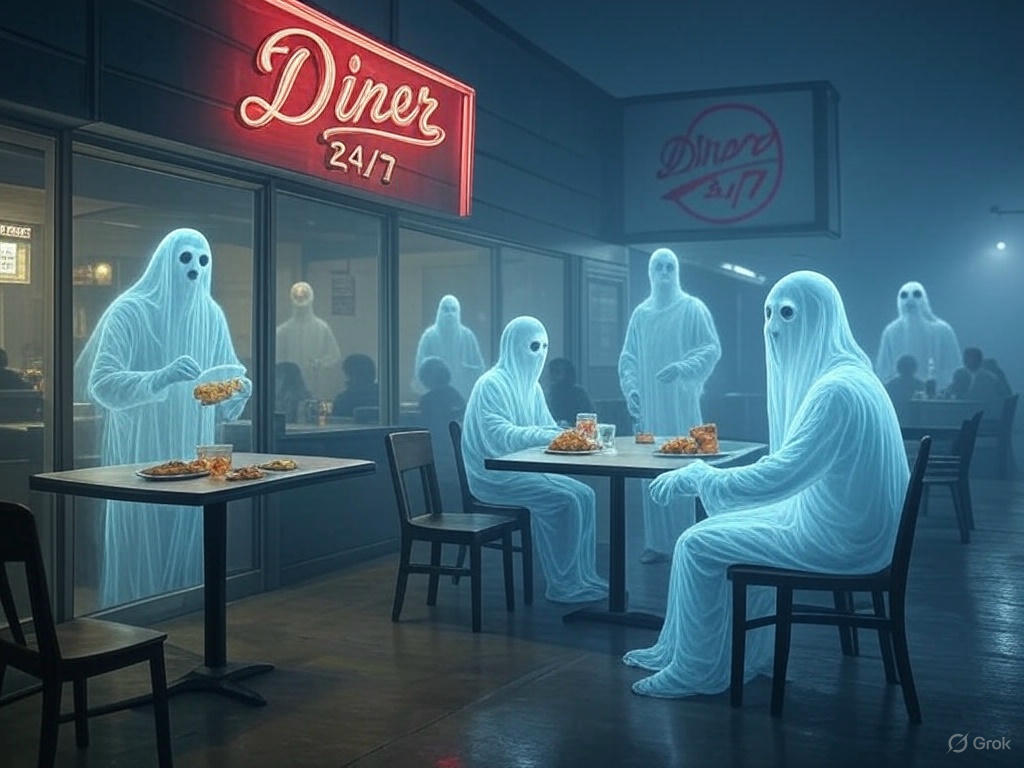
No time to ponder—I had to answer him. I told him, “Thai jasmine rice.” Before I could finish, the boss was at the table, waving me off impatiently. “Go check the rice sacks in the warehouse. Tell him exactly where it’s from!”
Heading back, I glanced over my shoulder. The long-faced guy’s exaggerated features loomed larger from afar, the boss beside him, bowing slightly, expression deferential. No interaction—just the man sitting regally, staring at me.
In the warehouse, I found the sacks: “Thailand, long grain.” I’d been played, but curiosity gnawed at me.
Before I stepped out, one of the girls rushed up, her face a mix of excitement and hesitation. I thought she’d seen something weird too. Nope—just gossip: her table might be a gay couple.
As we walked back, her next words nearly buckled my knees.
I’d said casually, “So many guests all at once—we’re only three. We’ll be swamped.”
She frowned, confused. “Three? It’s just us two. Mai-Ling left early—boss sent her home.”
Then: “And what ‘lots of guests’? I’ve got one table, you’ve got one.”
We reentered the restaurant. Same view, fog swirling outside, but the indoor haze was gone. More shocking? The place was empty. All 40-plus tables—vacant. The near-full scene from moments ago? Vanished like a gust of wind.
Naturally, I tried digging into this bizarre event afterward. But the more I investigated, the murkier it got—enough to make me wonder if I’d lost my mind.
I asked the boss about that night. He gave me his usual “I can’t be bothered” look but admitted the long-faced guy had asked about Thai jasmine rice. He even credited me the table’s tip. When I pressed for the bill to confirm, he clammed up, acting like it never happened.
The kitchen crew? Same old smirks and evasion. I grilled them—what was going on? Did they know something? Nada.
The female server on duty that night later became a close friend. She swore there were no other customers—just her table and mine, which she only knew about because the boss told her. She never saw the long-faced man.
Then came a twist that left us all stunned. Remember the stingy, fiery boss’s wife? She eventually left—turns out the boss had an affair with my server friend, who later became the new “lady boss.”
I didn’t stick around long—quit after six months. Up until I left, no one spilled what happened that foggy night. My gut says the boss knew something, and those chefs did too. But their lips stayed sealed.
I figured I’d never get answers. Then, just before leaving the U.S. to settle back in Taiwan, a fluke encounter brought me close to the truth. I met the original “Huang’s Garden” owner—Old Mr. Huang—through his daughter, a friend. He was a jovial, hefty man in his late seventies, long retired from the restaurant game. We crossed paths at a party at his place. As the young crowd chatted, he joined us.
The conversation drifted to my time at Huang’s Garden, and naturally, the foggy night came up.
My friends had heard this tale a dozen times over the years. We’d dissected every detail, ruled out me going nuts, and settled on it being an unsolvable mystery—lost to the ages.
But Old Mr. Huang, to our shock, had a story that shed light on what might’ve happened.
He explained a northern Chinese custom: merchants host an annual feast—dozens of tables for clients and partners. Tradition calls for one empty table, fully set with chairs, food, and drinks, reserved for local wandering spirits. It’s a thank-you to both the living and the spectral allies.
This “spirit table” is serious business—offered as a reward to the other side. If some clueless living soul sits there, the spirits might torment them. Huang recounted a rural legend, the “Head Feast,” about a merchant hosting such a banquet. His naive scholar nephew sat at the spirit table, and the ghosts challenged him to a drinking game—loser’s head gets gnawed on by the winners.
Still, rewarding the spirit realm could boost next year’s business, so some brave merchants took the risk.
One of Huang’s Garden’s chefs knew this ritual—family lore, he’d said. He claimed it could juice up restaurant profits and once pitched it to Huang, who shot it down. No such feasts happened on his watch.
So, a theory: if what I saw wasn’t a hallucination, the new boss might’ve boldly thrown a spirit banquet that night. By some cosmic fluke, I’d stumbled into the “scholar” role from the legend.
If it was a spirit feast, though, it didn’t work out. A few years later, Huang’s Garden tanked—bad business. No one took it over. It sat abandoned, then got razed for an office building, vanishing from the world.

 True TAIWAN Horror story
Leave a comment