Lately, there’s been a theory making the rounds: “Only 4% of the world consists of things we can see, touch, and verify. Another 20% is made up of things we can’t see or touch but can trace through their patterns. The remaining three-quarters—unseen, untouchable, and incomprehensible—form the backbone of the entire universe.”
The science we swear by fits snugly into that 4%. Meanwhile, phenomena like spirits, the supernatural, deities, feng shui, and divination likely belong to that 20%. Take the concept of “drifting” or ghostly presences, for example. In every era, you’ll find staunch skeptics armed with compelling theories to debunk it. Yet, the evidence speaks for itself: those skeptics are now long gone, reduced to dust and forgotten, while these mysterious phenomena persist, as resilient as ever, woven into human history from the very beginning. Today, people obsess over Marvel stories—proof enough that the fascination with the unseen endures.
The wonders of it all? Well, that’s for you to ponder.
When it comes to feng shui, there’s no shortage of curiosity—or skepticism. Over the years, I’ve become something of a “feng shui master collector,” meeting all sorts of experts in the “five arts” (geomancer, medicine, divination, future telling, and physiognomy).
Many of them defy the stereotype of wandering charlatans; they’re highly educated individuals who’ve shared fascinating insights with me. Drawing from their collective wisdom, I’ve pieced together a basic framework of feng shui principles. To keep this post from turning into a dry academic paper, I’ve detailed my take on feng shui in a separate blog entry.
But first, let me tell you a story about touching a tombstone.
The Tombstone Whisperer
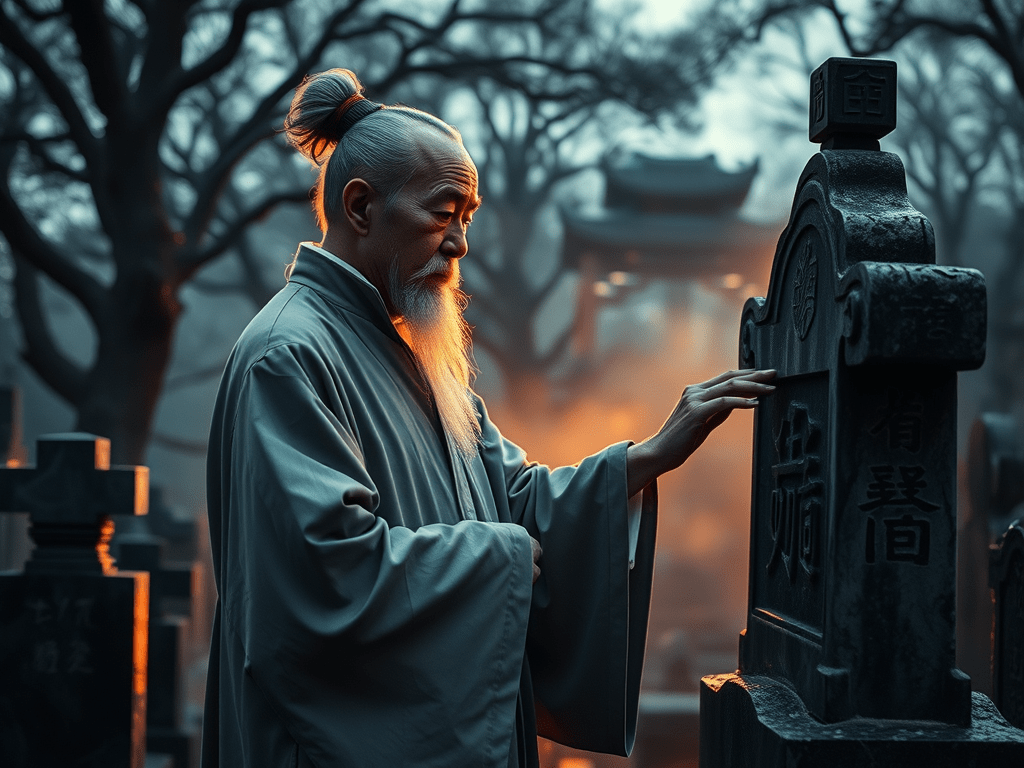
Some time ago, a wild rumor swept through the feng shui circles of southern Taiwan. Word was, there was a master so gifted he could touch a tombstone and instantly know the cause of the deceased’s death.
When Teacher Ji first heard this tale, he found it amusing and started asking around. To his surprise, the people he questioned looked at him with puzzled expressions.
“Who’s this mysterious master? Isn’t it you?”
As it turns out, the rumor began at a grand feng shui event hosted by a prominent southern family. This clan loved a big spectacle, so when they invited experts to assess their ancestral graves, they turned it into a lavish affair, complete with rituals and a lineup of feng shui specialists.
Teacher Ji was among the invitees. But the event dragged on—political speeches, endless ceremonies—and he quickly grew bored. So, he wandered off to explore the family’s sprawling cemetery, exchanging nods with a few colleagues along the way.
Eventually, he stopped at a tombstone belonging to a woman from the family, an elderly lady who’d passed away in her sixties. Standing there, Teacher Ji—perhaps struck by a playful whim—ran his hand lightly over the stone. Then, as if sniffing the air, he waved his hand in front of his nose.
Whenever Teacher Ji was around, his peers tended to watch him closely. Some even begged to tag along on his feng shui outings. Seeing this odd gesture, one of them couldn’t resist asking, “What are you doing?”
With a mischievous grin, Teacher Ji replied, “I’ve got it. This woman died of diabetes.”
It was a fleeting moment, one he forgot almost as soon as it happened. Bored with the event, he left early. What he didn’t know was that after he’d gone, someone relayed his comment to the family. They checked the woman’s cause of death—and sure enough, it was diabetes. From there, the tale of “a master who could touch a tombstone and reveal the cause of death” took on a life of its own, spreading like wildfire for quite some time.
Given the quirky nature of the feng shui world, Teacher Ji never bothered to clarify the story. He just let it simmer, neither confirming nor denying it.
Privately, though, he was an open book about what really happened.
The “tombstone touch” was pure theatrics—a little prank he’d pulled for fun. To onlookers, it seemed like magic. But the real trick? Earlier that day, he’d glanced at some of the deceased’s personal records provided by the family, including her birth data. Her name stood out to him. Later, at the tombstone, he saw her date of death etched in stone. Combining her birth chart with her passing, he deduced that diabetes was a likely culprit—and he was right.
In the end, it was simple deduction wrapped in a mystical veneer, turning a mundane moment into a legend.
This story got us talking about historical parallels, like Zhuge Liang “borrowing the east wind” during the Battle of Red Cliffs. Legend has it he performed a ritual to summon the wind, leading to Cao Cao’s defeat. Applying Teacher Ji’s lens, that ritual might’ve been a smokescreen—Zhuge Liang likely predicted the weather using his knowledge, then dressed it up as divine intervention to boost his mystique.
The Limits of Feng Shui
As I got to know Teacher Ji better, I couldn’t help but feel a childish thrill, like I’d befriended a real-life Doraemon—someone who could fix anything. I started dragging him along to help people with their problems. That is, until a bizarre incident taught me that while feng shui can explain a lot, making it work isn’t always so simple.
A friend of mine, a woman, reached out in distress. Her family had been fine until they moved into a new house. Then, disaster struck in waves.
First, her younger sister, barely in her twenties, caught a cold that spiraled into a coma. Doctors warned she might never wake up. Next, her father, a mid-level county official, got tangled in a subordinate’s corruption scandal. The subordinate pinned the blame on him, and if convicted, he faced 30 years in prison at age 60. Then her mother was hit by a car, losing a chunk of flesh from her leg.
All this unfolded within months of moving in. With my rudimentary feng shui knowledge, I suspected the house was to blame. My friend begged me to bring Teacher Ji to check it out—her father’s idea.
In feng shui, there’s a distinction between yin (graves) and yang (homes), so it’s not just about tombs—living spaces fall under its scope too.
I asked Teacher Ji, who lived in the south, to help my friend in central Taiwan. Generous as ever, he agreed to visit on a Sunday.
But then, something strange happened that Sunday morning…
Writer : Su Yiping
Time Stamp: 2012 Aug 21
From PTT Marvel Board

 True TAIWAN Horror story
Leave a comment