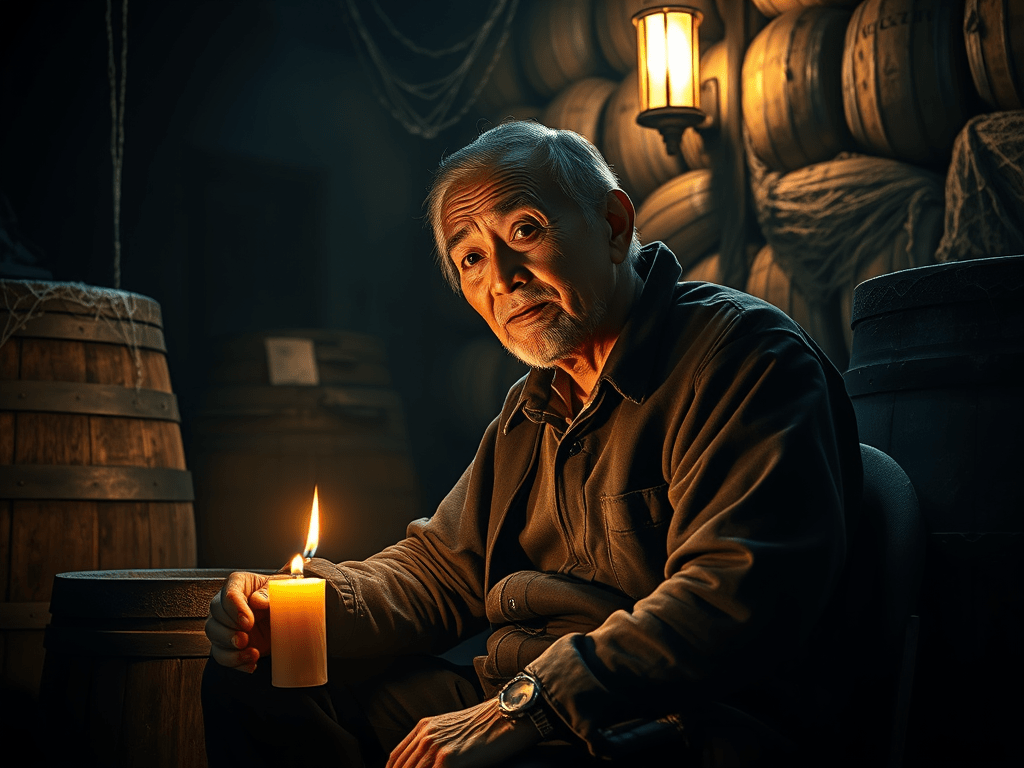
After the winery ghost fiasco in Puli, Xian Bo soon received his draft notice and shipped off to the military. Before leaving, curiosity drove him to dig into the Puli incident.
He consulted a few temple mediums, whose answers aligned: a neglected Japanese spirit, likely starved for offerings, was stirring trouble to get attention. Locals added that the winery had been a Japanese testing facility during colonial times, bombed in WWII, killing many—Xian Bo’s ghostly visitor possibly a lingering technician. Deeper answers eluded him, though. Too spooked, he vowed never to return to Puli, leaving the winery’s later chapters a mystery.
His military posting is in a remote mountain base in Pingtung—desolate, sparsely populated, home to just a few units. Post-Puli, Xian Bo said his “yin-yang eyes” kicked in; he’d catch glimpses of oddities now and then.
The barracks had its share of hauntings—camp disturbances, sleep paralysis—but he’d grown numb to it. He thought he’d seen it all, toughened up. Then, over a year in, came an encounter that nearly killed him.
It happened on a night when some veterans were retiring. Officers, Xian Bo included, joined them for drinks—a send-off bash. Young and reckless, they guzzled without restraint, collapsing in a drunken heap. Xian Bo was no exception.
Around 2 a.m., a full bladder roused him. Stumbling half-drunk, head throbbing but steady enough to walk straight, he staggered to the latrine—a detached shed from the main building.
A faint moon—not full—cast dim light. He remembered it clearly, glancing up and spotting his shadow in the glow. The latrine was darker, lit only by a feeble five-candlepower bulb near the sink. Mid-pee, something felt off. Two urinals over, a blurry figure loomed.
At first, he shrugged—another drunk soldier or officer, he figured. “Hey, peeing too?” he slurred. Silence. Sobering slightly, he squinted. Someone was there, but the gloom hid their face. He called out again—no reply. Now alert, he tensed.
This was an ammo-heavy unit during tense cross-strait years; an intruder was serious. As a sergeant, he carried a sidearm, even buzzed. Hand on his gun, he barked, “Who’s there? Speak!”
Nothing. Protocol from that era was clear: no response at night, even a general could be shot. Then the figure darted out the far door. Xian Bo gave chase.
Outside, moonlight offered faint visibility—20 meters ahead, clear enough. The “person” strolled casually—military shorts, long pants, like a soldier off-duty. Xian Bo sped up, keeping quiet; yelling in camp at night spelled trouble.
The figure was close, pace leisurely—catchable, he thought. Yet, oddly, despite his sprint, the gap held. The “man” didn’t run, just ambled, untouchable.
They exited the camp, reaching a flat expanse behind the mountain. Single-minded, Xian Bo didn’t clock how far he’d gone. At a dip in the terrain, the figure slipped below the horizon. He crested it—and it was gone.
A cold gust snapped him awake. Shivering, he realized he’d strayed five kilometers to the camp’s edge—a barbed-wire perimeter abutting wilderness, no soul for miles. Alone, theoretically, since his quarry vanished. Panic crept in. Head down, he turned back.
The night was still—no bugs, just eerie quiet under the moon. Had he retraced his steps then, maybe it’d have ended there. But as he started, a metallic clatter rang from the fence nearby. “Don’t look back,” he chanted internally, “you’ll regret it…”
This was Xian Bo, though—curiosity trumped sense. He peeked.
No pleasant sight awaited, but what he saw still floored him. Beyond the fence, a short Japanese soldier in mustard-yellow garb—leggings, rifle, a samurai sword nearly his height—marched stiffly back and forth.
The clanging is his blade scraping the wire with each pivot. A faint blue glow outlined him, illuminating every detail—except his face, shadowed by a low cap.
Another chill wind hit. Snapping out of it, Xian Bo screamed and bolted—his fastest run ever, he claimed, heart pounding like it’d burst, chased by an unseen terror. Camp lights grew closer. He didn’t stop until the latrine, collapsing at the sink.
Drenched in sweat—cold or hot, he couldn’t tell—he gasped, splashing water on his face to rinse off the dread. Eyes shut, he doused himself, then froze. Two sets of splashing sounds—his, and another beside him.
Wiping his eyes, he glanced over. A headless soldier “washing” at the tap, mimicking him, water hitting a severed neck stump. Xian Bo cursed his unclosable eyes.
Then the figure “turned”—a neck-twist with no head. As if that wasn’t enough, it unleashed a jerky, puppet-like dance—limbs flailing like a broken marionette zapped by voltage. That broke him. Emotions snapped; he passed out.
The brave young man, twice felled by ghosts in months (Puli’s anal stab the first), was found by a patrol, out cold by the sink. A month-plus in the military hospital followed—down from a robust 60-70 kilos to a skeletal 40-odd.
So ends the tale—now, our usual postmortem. Listeners always ask, “What move did that headless ghost pull to knock him out?” Xian Bo’s flair shone here, acting it out vividly.
As a teen hearing it, I couldn’t pin it down. Years later, it clicked: it matched Sadako’s crawl from The Ring—a disjointed, electrocuted-puppet stagger. Picture that, water splashing, and you’ve got Xian Bo’s fainting trigger.
It reminds me of a Malaysian writer pal’s uncle, a ghost-movie buff who’d watch anything—except The Eye with Angelica Lee. He’d turn his chair away while family watched the DVD.
Why? A yin-yang eye holder, he loved fake film ghosts but swore The Eye nailed the real deal—maybe the director saw them too. Likewise, Xian Bo’s headless mimicry echoed Sadako’s creepiness, bolstering my faith in his tales. No cracks in the details yet. The Ring’s creators likely saw something similar.
Post-illness, Xian Bo returned to duty, probing that night’s origins. No clear answers—camp sat on old battlegrounds and mass graves, a mashup of eras’ dead.
These two stories is from his 20s over 50 years ago, stand out as his wildest. He’s got more, but these two top the heap.

 True TAIWAN Horror story
Leave a comment